





 English
 Français
 Deutsch
 Italiano
 Русский
 Español
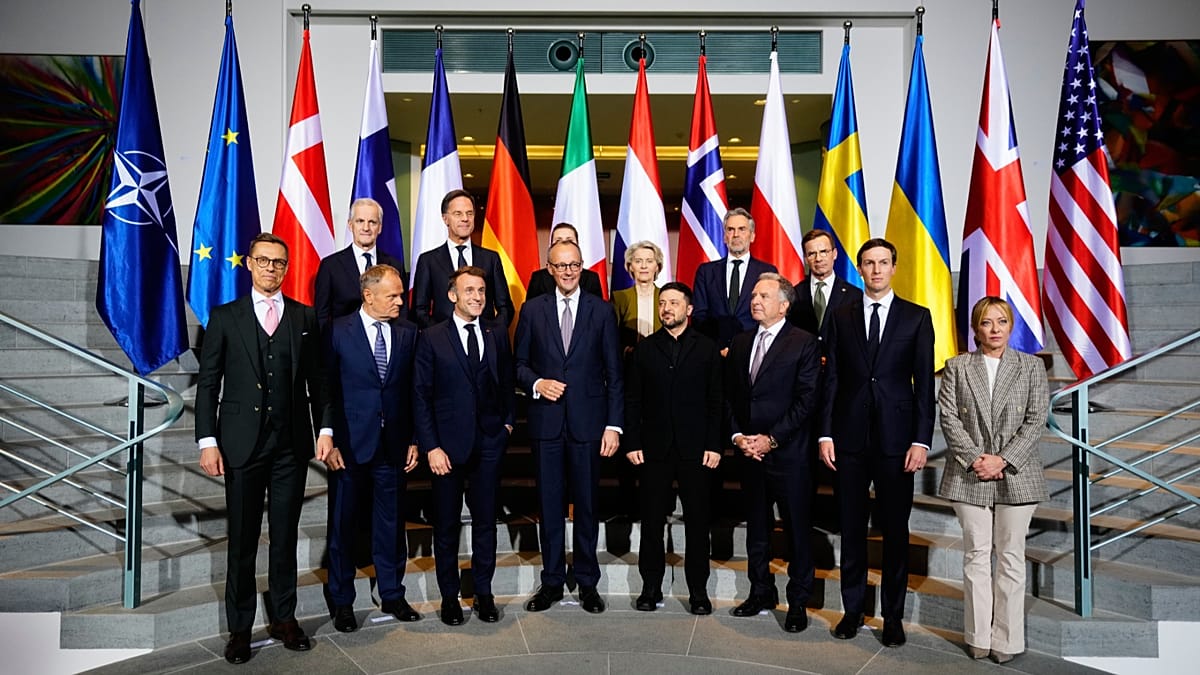
Ukrainian President Volodymyr Zelenskyy hailed progress with US negotiators after two days of talks in Berlin as European leaders committed to coming to Kyiv’s aid in a future attack by Russia to end a cycle of aggression extending more than a decade.
Still, questions remain over territories and the detailed functioning of how security guarantees, particularly those provided by the US, would work in practice.
Europeans also welcomed the outcome of the meetings, after which they listed assistance measures that would encompass “armed force, intelligence and logistical assistance, economic and diplomatic actions.”
In a joint statement released on Monday evening, European leaders provided their most detailed outline yet of the security guarantees they are willing to provide to Ukraine.
These include:
- “Sustained and significant support” for Ukraine’s armed forces, with a size of about 800,000 troops during peacetime.
- A European-led “multinational force” operating on Ukrainian soil, building on the work of the “Coalition of the Willing” chaired by France and the United Kingdom.
- A United States-led mechanism to monitor and verify an eventual ceasefire.
- A “legally binding commitment” to restore peace in case of a future armed attack, allowing countries to decide how they want to assist Ukraine.
- Investment in the recovery and reconstruction of Ukraine, while keeping the assets of the Russian Central Bank firmly immobilised.
- Ukraine’s accession to the European Union.
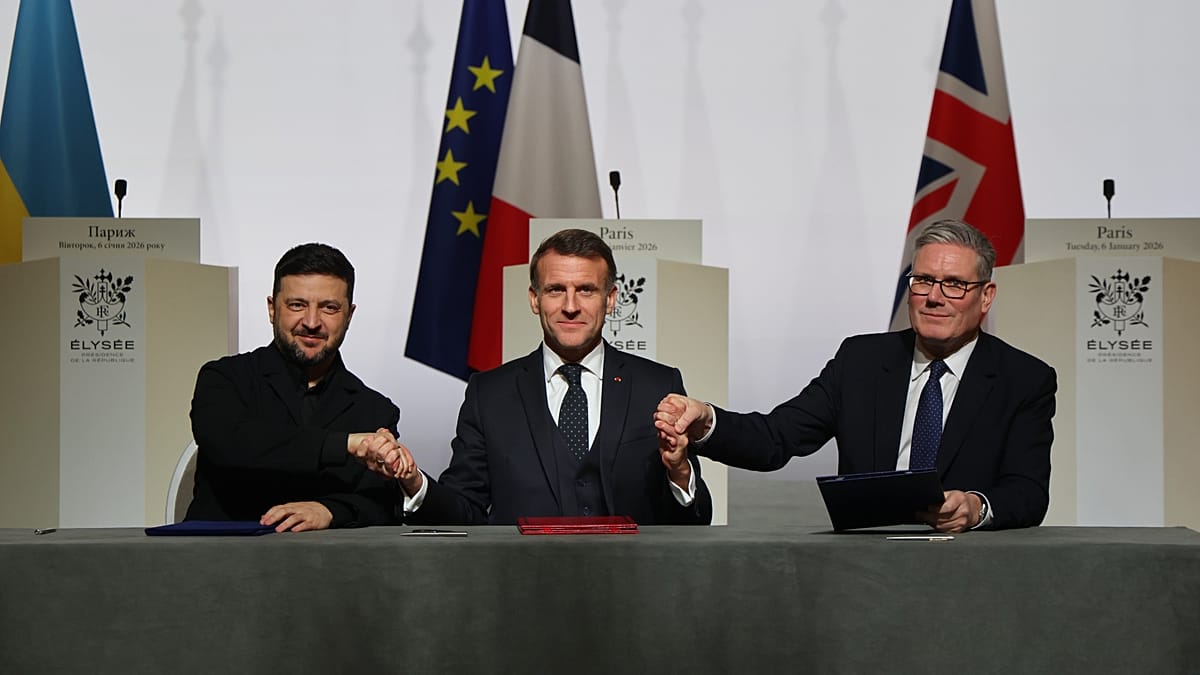
The statement was signed by German Chancellor Friedrich Merz, Danish Prime Minister Mette Frederiksen, French President Emmanuel Macron, Italian Prime Minister Giorgia Meloni, Netherlands Prime Minister Dick Schoof, Norwegian Prime Minister Jonas Gahr Støre, Polish Prime Minister Donald Tusk, Swedish Prime Minister Ulf Kristersson and British Prime Minister Keir Starmer.
It was also signed by European Commission President Ursula von der Leyen and European Council President António Costa and left open for other countries to endorse.
“In any deal, nothing is agreed until everything is agreed and all parties must work intensively towards a solution that could assure a lasting end to the fighting,” they said.
The two-day Berlin meeting was also attended by US special envoys Steve Witkoff and Jared Kushner, the son-in-law of President Trump, who met with Zelenskyy on Sunday.
European leaders joined on Monday for the second round of talks.
“I am grateful that we truly worked very well together,” Zelenskyy said on social media.
“There are some things that, in my view, are destructive and would definitely not help us. It is important that they are no longer present in the new versions of the documents. This matters, because dignity matters.”
Zelenskyy said territories were the most difficult issue of the negotiations due to the vast disagreements with Russia, which is intent on taking as much land as possible.
“I believe that the American side, acting as a mediator, will propose various steps to try to find at least some form of consensus,” he said.
“We will do everything possible to find clear answers to questions about security guarantees, territories, and money as compensation for Ukraine to rebuild.”
Challenging Moscow
In their joint statement, European leaders stressed that any decision on territory should be made by the Ukrainian people “once robust security guarantees are effectively in place” and promised to support Zelenskyy if he chooses to hold a referendum.
“International borders must not be changed by force,” the leaders said.
Europeans urged Russia to “show willingness to work towards a lasting peace” by agreeing to the peace plan promoted by the White House and establishing a ceasefire, a crucial step that Russian President Vladimir Putin has repeatedly refused to take.
Notably, the statement does not feature any fixed deadline to admit Ukraine into the EU, after previous media reports spoke about January 2027. The European Commission says the process must remain “merit-based” according to each candidate’s evolution.
“Any deal should protect the long-term security and unity of the Euro-Atlantic and the role of NATO in providing robust deterrence,” they said. “Any elements affecting the EU and NATO will be discussed among EU and NATO members, respectively.”
A source close to the negotiations in Berlin celebrated the fact that the US had agreed to participate in the security guarantees, given the country’s military capabilities and intelligence gathering, which Europeans are not yet able to match.
“The US will be the backstop and provide intelligence, air support capabilities that nobody else can,” the source told Euronews, noting the main centre of operations will be the Ukrainian army backed by the multinational force of the “Coalition of the Willing”.
“Each nation will speak to what they’ll do in Ukraine as part of this, but it’s expected to be multi-domain: land, sea, air, cyber and space.”
The diplomatic breakthrough in Berlin comes days before EU leaders are set to gather in a crucial summit in Brussels to decide how to raise €90 billion to finance Ukraine’s budgetary and military needs for 2026 and 2027.
The main proposal on the table is a zero-interest reparations loan based on the immobilised assets of the Russian Central Bank, which has met with the opposition of Belgium, the prime custodian of the funds, and reservations from Italy, Bulgaria, Malta and the Czech Republic, casting doubt over its approval.
“I understand the concerns. I don’t share the concerns,” Merz said on Monday. “But I very much hope that Belgium, the country most impacted by this decision, will take a step in the right direction with us. It’s expedient to support Ukraine.”
This article has been updated.
Read the full article here